
Hydrogen Helicopter Research
![Unither researchers and AGRC students in front of the hydrogen helicopter.]](/sites/agrc.umd.edu/files/styles/optimized/public/2026-09/hydrogen-heli_team-photo.png?itok=WCf1jJKx)
AGRC-Unither Collaboration
Researchers in the Alfred Gessow Rotorcraft Center are collaborating with Unither Bioelectronics in advancing hydrogen-powered vertical flight, building on years of foundational work that helped enable this first piloted hydrogen fuel cell helicopter flight.
Since then, the helicopter has been flight tested extensively in hover, hover taxi, level flight up to 70 kts, climb, descent, and maneuvers. These flights validated the feasibility of hydrogen helicopters en-visioned in papers by students in the University of Maryland Alfred Gessow Rotorcraft Center.
The UMD-Unither paper, "Exploration of a Full-scale Hydrogen Fuel Cell Powered Helicopter through Flight Tests and Analysis (PDF),” presented at the Vertical Flight Society's Annual Forum in 2026 by AGRC graduate student Yuval Enciu describes some of these collaborative efforts and earned a VFS Best Paper Award in eVTOL.
The test data from this experimental aircraft is now being used to research and develop larger and more capable helicopter—supplied with hydrogen from liquid hydrogen tank—with integrated aero-mechanical design to overcome many fundamental barriers.
Foundational Research
Years of research by AGRC students and faculty preceded the first hydrogen flight. Key publications include:
- Ng, W., Patil, M., and Datta, A., “Hydrogen Fuel Cell and Battery Hybrid Architecture for Range Extension of Electric VTOL (eVTOL) Aircraft (PDF),” Journal of the American Helicopter Society, Vol. 66, 2021, Article 012009. https://doi.org/10.4050/JAHS.66.012009.
- Ng, W., and Datta, A., “Hydrogen Fuel Cells and Batteries for Electric-Vertical Takeoff and Landing Aircraft (PDF),” Journal of Aircraft, Vol. 56, No. 5, 2019, pp. 1765–1782. https://doi.org/10.2514/1.C035218.
- Datta, A., and Johnson, W., “Powerplant Design and Performance Analysis of a Manned All-Electric Helicopter (PDF),” Journal of Propulsion and Power, Vol. 30, No. 2, 2014, pp. 490–505. https://doi.org/10.2514/1.B34843.
The NASA CR-20210000284 "PEM Fuel Cell Model for Conceptual Design of Hydrogen eVTOL Aircraft (PDF)," and accompanying open-source software are intended to inspire the broader community toward hydrogen flight.
The report gives a brief history of hydrogen fuel cell flight (Chapter 2), current hydrogen infrastructure in the US (Chapter 3), and ends with key conclusions (Chapter 15), and requirements and recommendations for a flight test bed (Chapter 16). Chapters 4-14 are for engineers interested in conceptual sizing. The software for the model used is also included (Chapter 18) so that anyone could use it for further study and analysis.
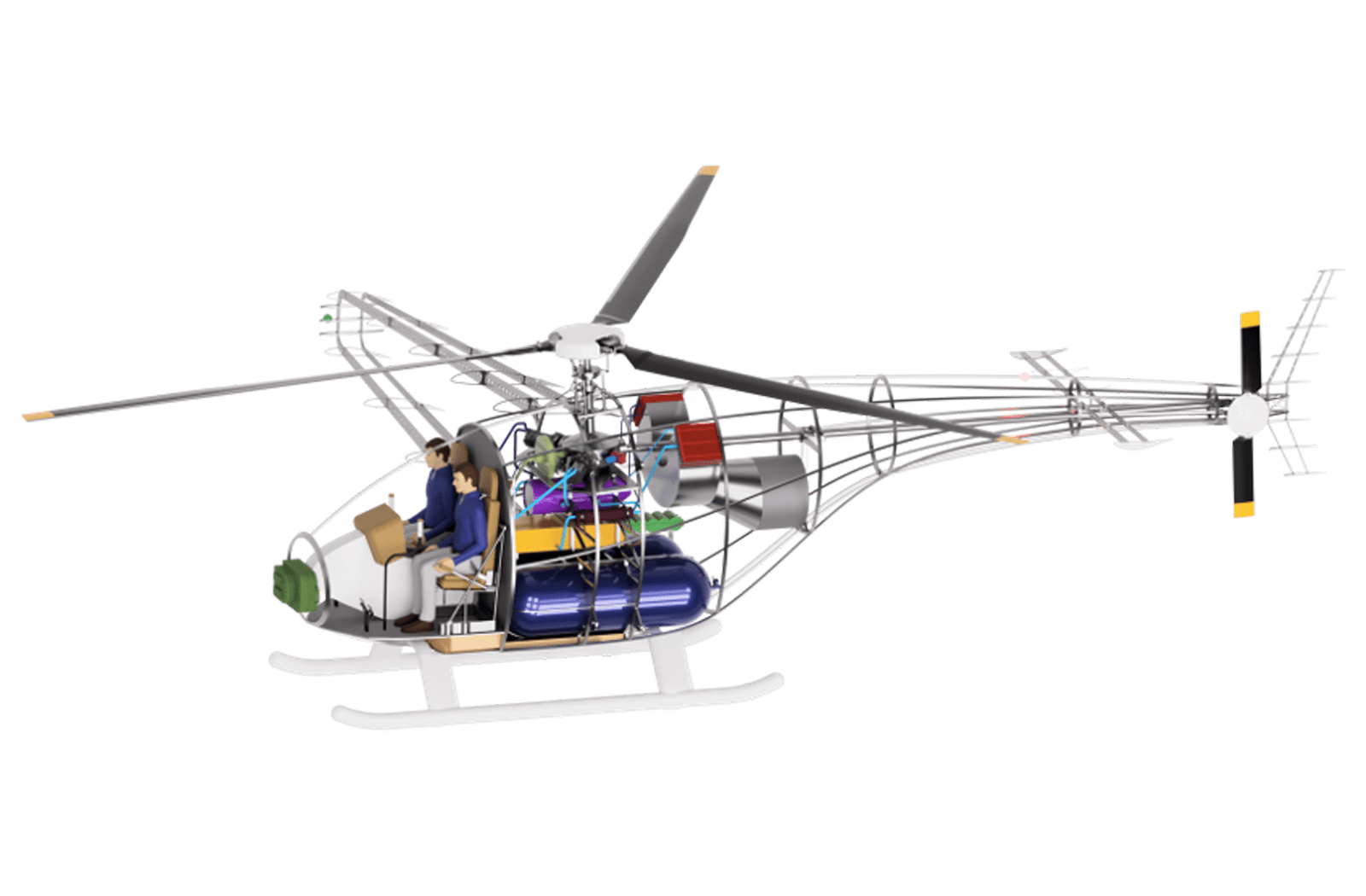
VFS International Design Competition
The 2025 annual Vertical Flight Society (VFS) Student Design Competition, sponsored by Airbus, challenged participants to push boundaries to design a next-generation VTOL aircraft powered exclusively by hydrogen-based, electric propulsion.
Thae 2025 competition included 20 entries from 16 universities across 10 countries and seven U.S. states.
Led by faculty advisers V. T. Nagaraj, T. Krysinsky and Inder Chopra, the University of Maryland aerospace engineering students rose to the complex challenge, taking both category first-place prizes with their graduate team’s Wyvern (cut-away drawing seen below) and undergraduate team’s Draco designs.
The graduate team was led by Kumardip Basak and included Apurva Anand, Brett B. Sweeny, Dogyu Jun, Hussien A. A. H. Hussien, Jacob C. McCallum, Radu Teodorescu, Remi J. Hensel, and William M. Ogle.
The undergraduate team was led by Samuel Renz and included Joshua Katz, Colby Cotoia, Ron Berlin, Billy Lee, Ishmael Agui, and Isaiah Lee.
Learn More About VFS Design at MarylandElectric Aviation Laboratory
Experimental research in this area is conducted in the center’s Maryland’s Electric Aviation Laboratory.