
Research
Research at the University of Maryland Alfred Gessow Rotorcraft Center is comprised of the following Major Thrust Areas:
Current & Recent Programs
Team: University of Maryland; University of Texas, Austin; Texas A&M; U.S. Naval Academy
DARPA—FLIGHT-MAV: Flow Learning for Informed Geometry of Hovering Technologies in Micro Air Vehicles
Team: University of Maryland; University of Michigan; Rensselaer Polytechnic Institute (RPI)
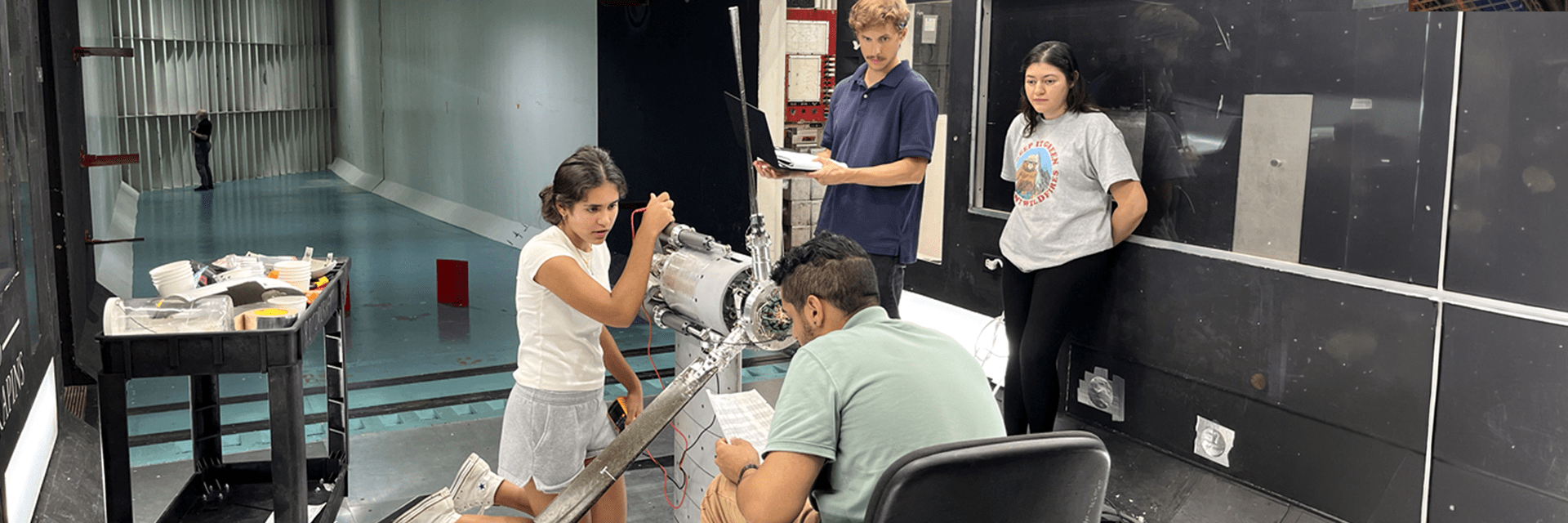
- Low Reynolds number Rotor Rig Experiments
- Machine Learning for Macroscale Design-Principle Discovery
- Rotor System Optimization/Design
United Therapeutics—Revolutionary Advancements towards H2-Powered Manned All-Electric Rotorcraft for Organ Delivery
Team: University of Maryland and United Bioelectronics
- Advanced modeling and validation of a helicopter hybrid fuel cell system
- Fundamental understanding, modeling, and flight test validation of gaseous and liquid hydrogen helicopter
KARI—Development of High Performance Low Vibration Lift Prop System for a 5-seat eVTOL
Team: University of Maryland; Korea Aerospace Research Institute; Korea Aerospace Industries
- Fundamental aerodynamics and CFD/AI-based design of a lift prop
- Fundamental loads and vibration of a lift prop on a flexible support
Boeing Rotorcraft Research
Team: University of Maryland and Boeing Philadelphia
- Exascale integrated-3D simulation and Mach-scale hover and wind-tunnel tests of double anhedral rotors
- High-speed hingeless compound rotor interactions
U.S. Navy, NAWCAD-NAVAIR
- Autonomous shipboard landing
- Mitigation of Tiltrotor Whirl-Flutter through Pylon CG Placement
- Swept-tip Composite Blades for High-Speed Tiltrotors
NASA
Team: University of Maryland and NASA Ames Research Center
- Three-dimensional Aeroelastic Behavior of Mars Rotors
- Fuel cell model for rotorcraft conceptual design
Major Past Programs
The AGRC has led many multi-year national programs on inter-disciplinary science and technology barriers of vertical lift.
The major programs are listed below. For past VLRCOE programs see VLRCOE.
| Sponsor | Program | Years | Team | Faculty | Grad Students | Budget |
|---|---|---|---|---|---|---|
| Army Research Laboratories (ARL) | Micro Autonomous Systems and Technology – Collaborative Technology Alliance (MAST-CTA) — Center for Microsystem Mechanics | 2008-2018 | UMD, Berkeley, GaTech, Harvard, Caltech, UTA, TAMU, NCA&T | 20 | 27 | $23M |
| Army Research Office (ARO) | MURI — Micro Hovering Air Vehicles | 2004-2010 | UM, NCA&T | 17 | 24 | $11.5M |
| AFOSR | MURI — Rotorcraft Brownout | 2008-2014 | UMD, ASU, Dartmouth, Iowa State | 9 | 15 | $7.50 |
| DARPA | Helicopter Quieting Program | 2004-2006 | UMD Stanford | 7 | 10 | $3.5M |
| ARO | MURI — Innovative Smart Technologies for an Actively Controlled Jet-Smooth Quiet Rotorcraft | 1996-2001 | UMD, Penn State, Cornell | 18 | 21 | $5M |
| ARO | Innovations and Applications of Smart Structures | 1992-1997 | UMD: Aero, Mat, ECE, Mech, UMBC | 14 | 20 | $2.8M |