
About
The University of Maryland's rotorcraft center was founded by Alfred Gessow in 1982 when the Army competitively selected his five-year proposal to establish a Center of Excellence for Rotary Wing Aircraft Technology (CERWAT) in the Department of Aerospace Engineering at Maryland.
It was one of only three such centers created in the U.S., along with the Georgia Institute of Technology and Rensselaer Polytechnic Institute, dedicated to multi-/interdisciplinary research and education on the science and technology of vertical lift aircraft.
Since then, through nine competitive Army renewals, and supplemented by many other national programs, the University of Maryland Alfred Gessow Rotorcraft Center (AGRC) has produced 200+ doctoral students, 300+ master’s students, 30+ rotorcraft faculty world-wide, and remains one of only three U.S. Army, Navy, NASA-designated Vertical Lift Research Centers of Excellence (VLRCOE) in the nation, along with the Georgia Institute of Technology and Pennsylvania State University.
The Evolution of AGRC
Alfred Gessow joined Maryland in 1980 as the Chair of the Department of Aerospace Engineering. His first hire in rotorcraft was Inderjit Chopra in 1981. Gessow and Chopra were the main architects of CERWAT, and helped expand UMD's rotorcraft faculty significantly during the 1980s.
- Gordon Leishman (Aerodynamics, 1986)
- Anthony Vizzini (Composite Structures, 1986)
- Roberto Celi (Flight Dynamics & Controls, 1987)
In 1992, Alfred Gessow took emeritus status and Inderjit Chopra became the new center director.
In 1997, Andrew Gessow gave a $1.33 million gift to the Clark School of Engineering to honor his parents Alfred and Elaine Gessow.
This endowment created the Alfred Gessow Rotorcraft Center—a broader umbrella and a permanent home for rotorcraft research at Maryland—and an Alfred Gessow Endowed Chair meant for the center director. Inderjit Chopra became the first Alfred Gessow Endowed Chair.
The rotorcraft faculty was further expanded during the 1990s with the additions of:
- Jim Baeder (CFD, 1993)
- Norm Wereley (Smart Structures, 1993)
- Darryll Pines (Transmission & Health Monitoring, 1995)
- VT Nagaraj (Design, 1997)
- Fred Schmitz (Acoustics, 1998)
The years 2000-2020 brought significant changes.
Darryll Pines became the Department of Aerospace Engineering Chair (2006-2009), then Dean of the Clark School (2009-2020), and then University of Maryland President (2020). Norman Wereley succeeded Pines to became Department Chair in 2009. Vizzini moved and Schmitz, Leishman, and Celi retired.
From 2010-2025, the department hired additional new faculty to address gaps and emerging areas of research:
- Anubhav Datta (eVTOL, 2016)
- Olivier Bauchau (Multibody Dynamics, 2016)
- Umberto Saetti (Haptics, 2022)
- Chloe Johnson (Acoustics, 2024)
In 2014, Sikorsky created another chair professorship at the center—the Igor Sikorsky Endowed Chair. The distinguished scholar and researcher Olivier Bauchau joined AGRC as the first Sikorsky Chair. When Bauchau retired in 2021, Jim Baeder was elected to be the second Sikorsky Chair, and Saetti moved in 2025.
In 2024 Anubhav Datta was elected as the Alfred Gessow Endowed Chair.
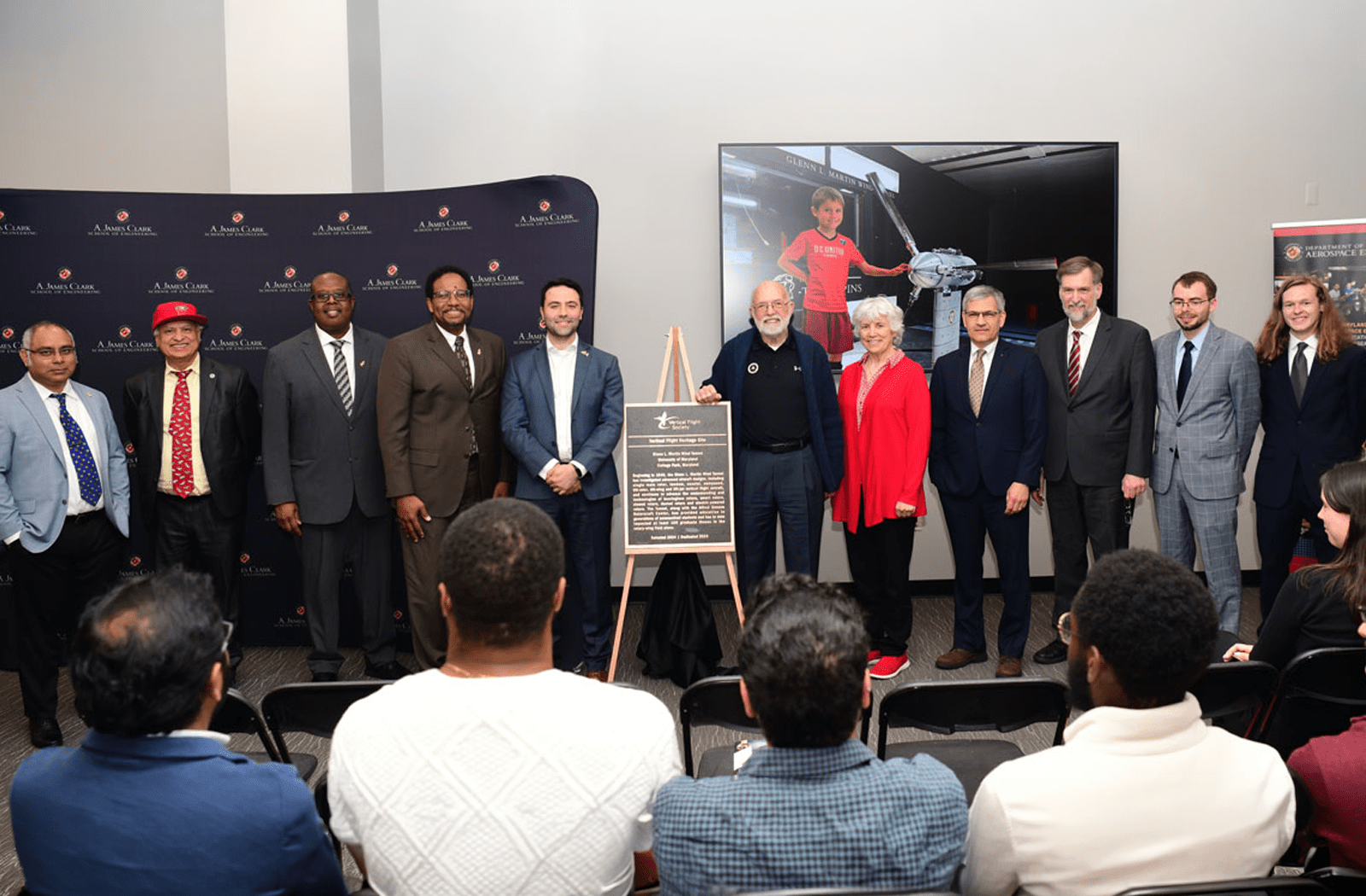
A Vertical Flight Heritage Site
"Beginning in 1949, the Glenn L. Martin Wind Tunnel has investigated advanced aircraft designs, including single main rotor, tandem, coaxial, compound, tilt-rotor, tilt-wing and lift-jet vertical flight aircraft, and continues to advance the understanding and technologies of bearingless rotors, smart rotors, slowed rotors, ducted rotors and electric-powered rotors. The Tunnel, along with the Alfred Gessow Rotorcraft Center, has provided education to generations of aeronautical students and has to date impact at least 100 graduate thesis in the rotary-wing field alone."
Vertical Flight Heritage Site designation by the Vertical Flight Society, presented on April 16, 2025
Read more about this historic milestone.