
VLRCOE
The Vertical Lift Research Center of Excellence (VLRCOE) program is funded jointly by the U.S. Army, Navy, and NASA to conduct basic research research and graduate education in vertical lift technology in a concentrated interdisciplinary center. There are only three funded VLRCOEs nationwide.
The center is led by UMD with partners at the U.S. Naval Academy, University of Texas at Austin, and Texas A&M University.
There are currently 13 projects, each led by a PI, but conducted in a coordinated and collaborative manner with other projects.
- Transient Loads and Wake Measurements for Dynamic Control Inputs on Coaxial Rotors. Jayant Sirohi (UT Austin)
- Aeromechanics Measurements, Validations, and Innovations for High-Speed Advanced Compound Rotorcraft. Inder Chopra (UMD)
- Measurements and Modeling of Helicopter Operation in Confined Environments. Joe Milluzzo (U.S. Naval Academy)
- High-Fidelity Aeromechanics of Representative Advanced Air Mobility Configuration During Transitional Flight. Jim Baeder (UMD)
- Integrated-3D Toward Exascale Aeromechanics. Anubhav Datta (UMD)
- Dynamics and Control of Multiple Interacting Heterogeneous Rotorcraft in Ground Effect. Ondrej Juhasz (U.S. Naval Academy)
- UAS System Identification and Control for Safe Proximity Flight. Derek Paley (UMD)
- Wind-tunnel Measurements and High-Fidelity Predictions of Whirl-Flutter and Vibratory Loads on Advanced Geometry Tiltrotors. Anubhav Datta (UMD)
- Fundamental Understanding and Novel Control of Performance, Loads and Acoustics of a Stacked Rotor Through Indexing Using Measurements and Validated Predictions. Jayant Sirohi (UT Austin)
- Aeromechanics, Flight Dynamics and Control of Air-Launched UAS. Moble Benedict (Texas A&M University)
- Aeroelastic Stability Measurement and Validation for High-Mu Articulated and Hingeless Rotors. Inder Chopra (UMD)
- Integrated Power-Platform Innovations for Hybrid-electric Rotorcraft. Mumu Xu (UMD)
- CFD Trained Neural Networks and Machine Learning Inverse Design of Rotorcraft Components. Jim Baeder (UMD)
Since its founding in 1982, the Rotorcraft Center has been awarded nine competitive renewals. The designation has undergone several name changes from the Center of Excellence for Rotary Wing Technology (CERWAT) to the current Vertical Lift Research Center of Excellence (VLRCOE), but the mission has remained the same—to establish dual-use knowledge base in vertical lift and train the next-generation of leaders through a highly collaborative, coordinated, and tight-knit research and educational environment with U.S. Government and Industry.
The renewals are listed below.
| Sponsor | Program | Years | Team | Budget |
|---|---|---|---|---|
| Army/Navy/NASA | Vertical Lift Research Center of Excellence (VLRCOE) | 2021-2026 | UMD, USNA, UT Austin, Texas A&M | $8.5M |
| Army/Navy/NASA | Vertical Lift Research Center of Excellence (VLRCOE) | 2016-2021 | UMD, USNA, UT Austin, Texas A&M, RPI | $11.5M |
| Army/Navy/NASA | Vertical Lift Research Center of Excellence (VLRCOE) | 2016-2021 | UMD, USNA, UT Austin, Texas A&M, RPI | $11.5M |
| National Rotorcraft Technology Center (NRTC) Army, Navy, NASA & FAA | Center for Rotorcraft Education and Research (CRER) | 2001-2006 | UMD | $4.64M |
| National Rotorcraft Technology Center (NRTC) Army, Navy, NASA & FAA | Center for Rotorcraft Education and Research (CRER) | 1996-2001 | UMD | $4.6M |
| Army Research Office (ARO) | Augmentation | 1994-1996 | UMD | $1.75M |
| Army Research Office (ARO) + Industry (Bell, Sikorsky, Boeing, & MD) | Center of Excellence in Rotorcraft Technology (CERT) | 1992-1995 | UMD | $4.75M |
| Army Research Office (ARO) | Center of Excellence for Rotary Wing Technology (CERWAT) | 1987-1992 | UMD | $5.5M |
| Army Research Office (ARO) | Center of Excellence for Rotary Wing Technology (CERWAT) | 1982-1987 | UMD | $6M |
Curriculum
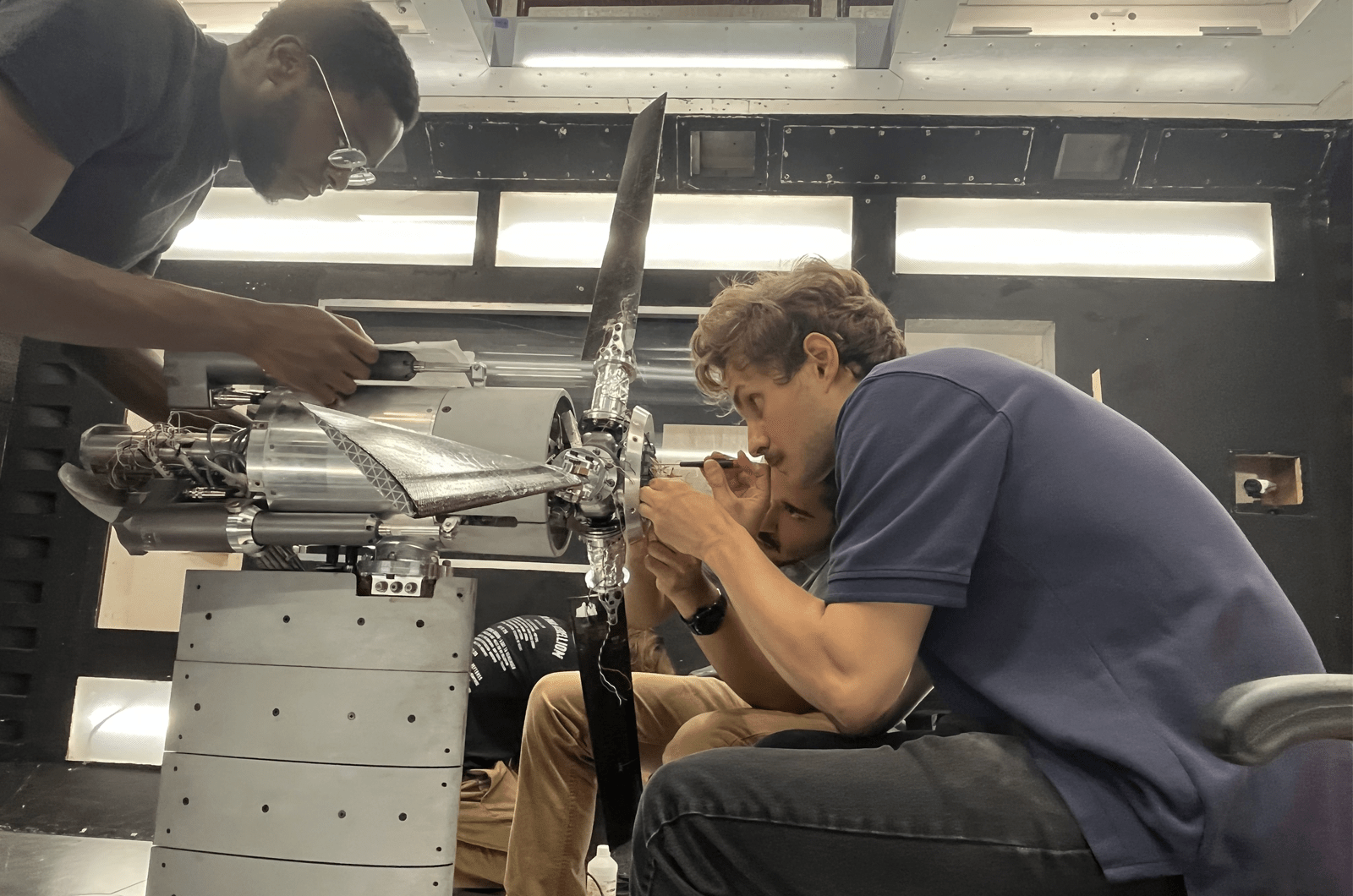
VLRCOE includes structured rotorcraft curriculum covering aerodynamics, structural dynamics, aeroelasticity, flight mechanics and controls, CFD, and rotorcraft design.
Graduate Courses