
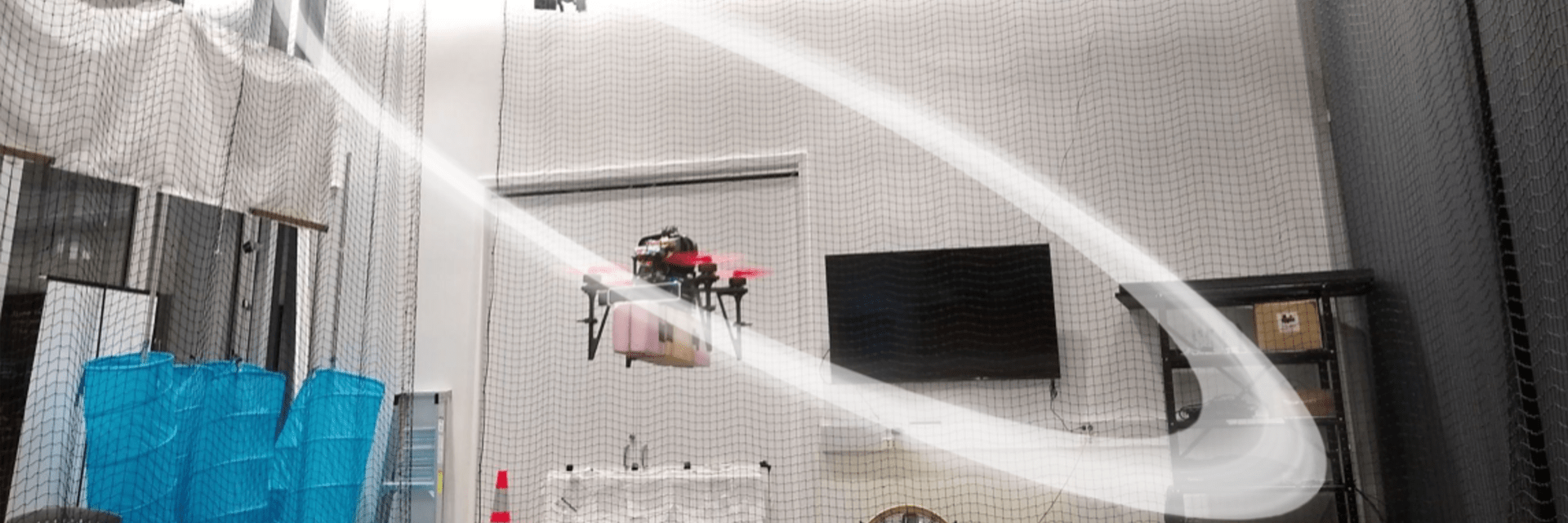
UAS/Counter-UAS and Autonomy
Autonomy and UAS research at Maryland combines counter-UAS, control for safe proximity flight, vision-based ship-deck landing, and micro- to small air vehicle platform technologies.
Maryland's Ship-Deck Platform Facility supports this research and the testing of autonomous rotorcraft operating in challenging environments.
Counter UAS Research
Counter UAS research explores innovative and disruptive methods such as acoustics-based detection and elimination. Drones are custom-built in-house with special sensors and on-board processings, and the algorithms are tested with indoor flight tests conducted in the 20- by 40-ft UAS and autonomy laboratory. The test data is used to refine the algorithms and validate predictive tools.
Faculty

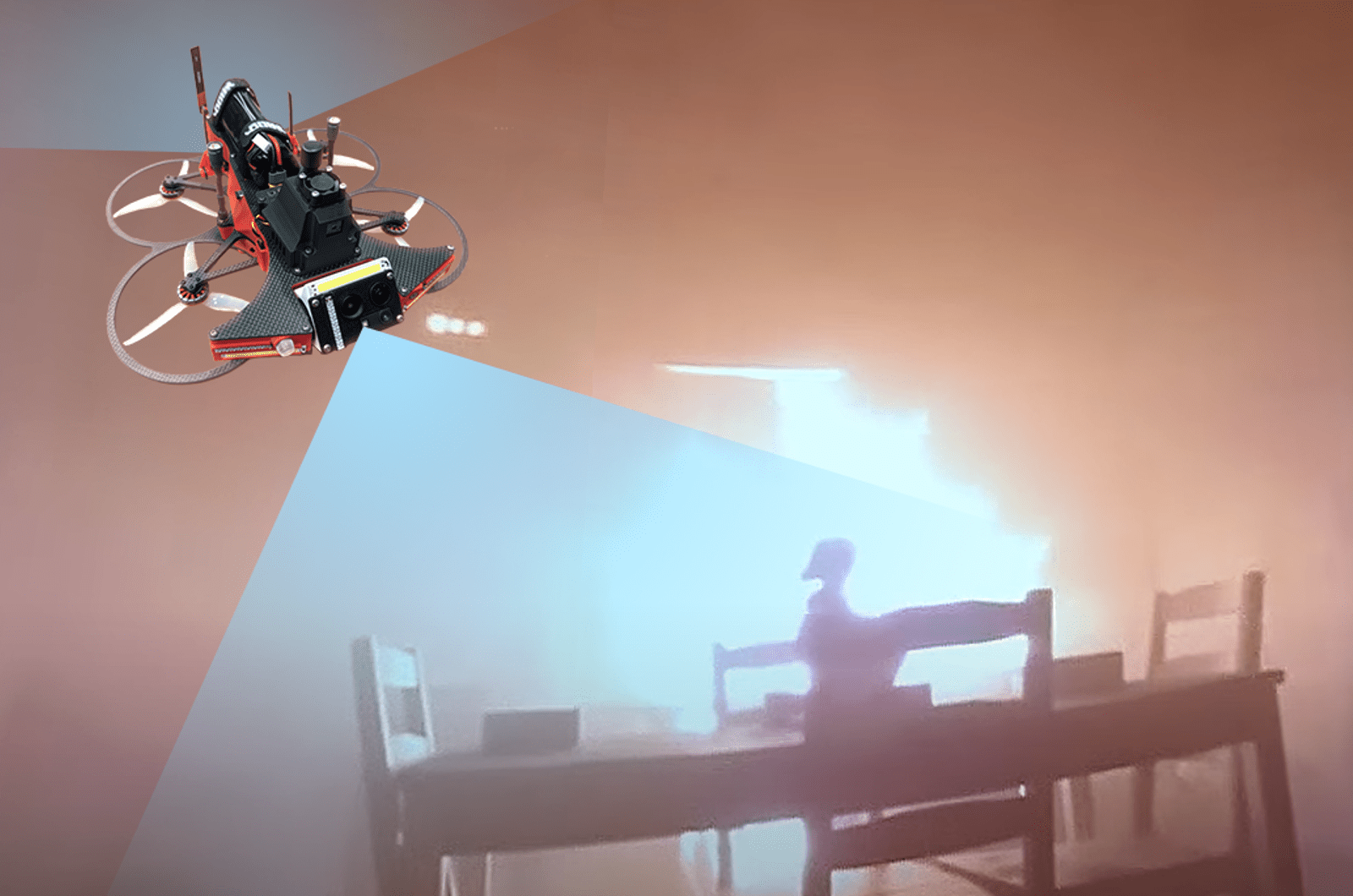
Control for Safe Proximity Flight
Control for safe proximity flight includes indoor and outdoor flight and confined and congested areas. The primary objective is to apply tools from rotorcraft dynamics, nonlinear control, and system identification to construct a principled framework for self-calibration that achieves a high degree of robustness and adaptability to various vehicle classes and payloads without performing full sensor/motor calibration or manual tuning. A secondary objective is to enhance the safety and operational performance of a dense UAV swarm flying in a cluttered environment.
The main significance lies in enabling drones to achieve self-awareness to operate in challenging conditions without operator intervention while minimizing development/testing time and costs.
Faculty

Vision-based Ship-deck Landing Research
Vision-based ship-deck landing research combines flight dynamics, controls and computer vision to develop 2D and 3D feature-based algorithms, that are repeatable and deterministic, for landing on ship-decks under GPS/Lidar-denied degraded visual conditions, autonomously, with no systems on the ship and drone vision alone. Algorithms are tested on custom-built drones on a 1.5-ton platform that can reproduce stochastic motions up to sea state 7 of typical DDG-51-class of vessels. Degradation covers occlusion, low illumination, glare and water distortion.
Faculty

Air Vehicle Platform Technologies
Air vehicle platform technologies develop configurations that harness new aeromechanics of unsteady flows and vertical lift to maximize payload and range/endurance tailor-made to scale.
Various special-purpose drone configurations are fabricated and tested.
They range from the typical quad-rotor, to flapping wings, cyclocopters, ducted rotors, quad biplane tail sitters and the da Vinci screw. Research is focused on unsteady aerodynamics at low Reynolds numbers (1000-10,000), microsystem mechanics, ultra-light structures, and novel means of control.
The Gamera human powered helicopter explores the opposite end of the size spectrum. It is a large quad-rotor meant for human power that is now being converted to solar power.