Computational Aeromechanics
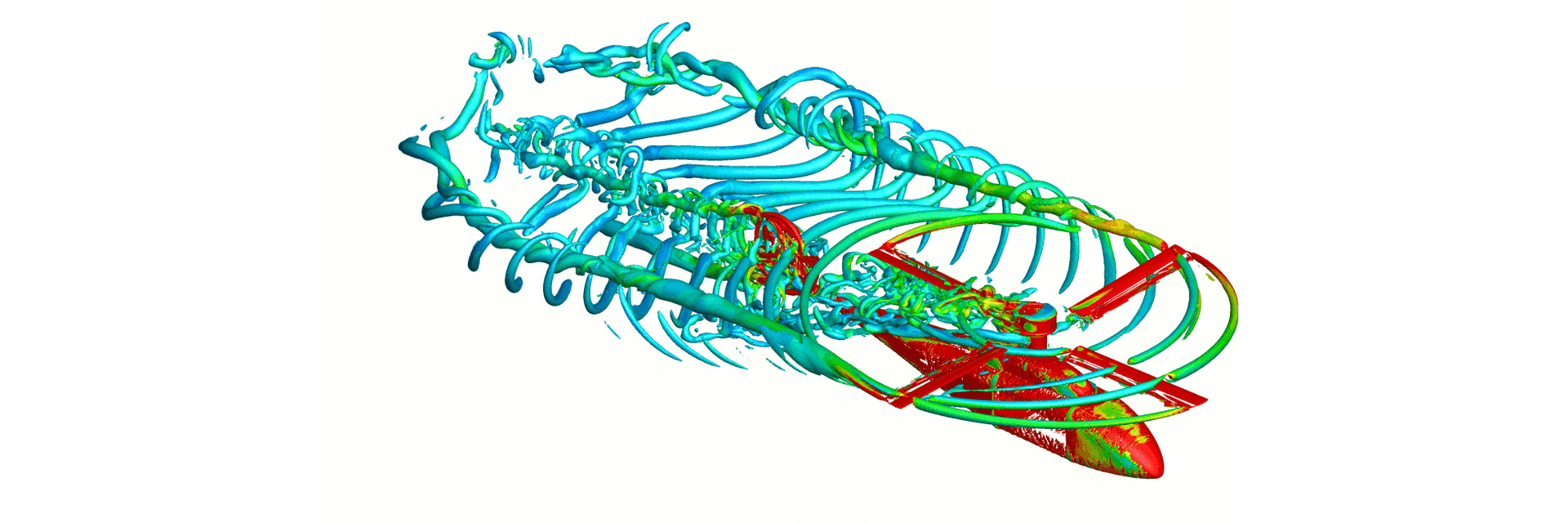
Computational Aeromechanics combines Computational Fluid Dynamics (CFD), Computational Structural Dynamics (CFD), lower-order Comprehensive Analysis (CA), and coupling of fluids and structures to inquire about special problems of rotary-wing flows and structural motions.
Research in these areas is conducted in the Computational Aeromechanics Laboratory, housed in UMD's IDEA Factory and is supported by UMD's flagship High-Performance Computing cluster Zaratan.
Computational Fluid Dynamics
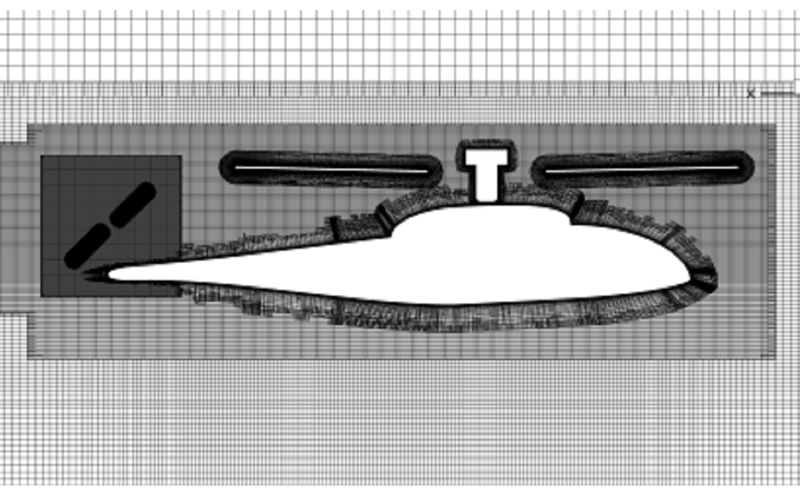
Computational Fluid Dynamics (CFD) research seeks to understand and predict rotary-wing flows by solving Reynolds Averaged Navier-Stokes equations. Rotary-wing flows are unsteady, three-dimensional, vortical, turbulent and transonic in nature, characterized by oscillatory shocks, dynamic stall, complex transition, unique acoustics, interactions between rotating and fixed components, and interaction with flexible structures.
They require special algorithms for meshing, domain connectivity, turbulent transition, High Performance Computing on CPUs and GPUs. One of the first Navier-Stokes solvers for rotorcraft—TURNS was developed at Army/NASA Ames Research Center and later at AGRC as UMTURNS.
Today a modern suite of solvers are continuously being developed and used for research at AGRC under a framework called MERCURY that includes OverTURNS—a structured CPU solver, HAMSTR—an unstructured CPU solver, and GARFIELD—a structured GPU solver.
Research ranges from understanding and predicting complex flow physics to utilizing modern AI/ML algorithms and quantum computing tools for inverse design and optimization.
Faculty

Computational Structural Dynamics
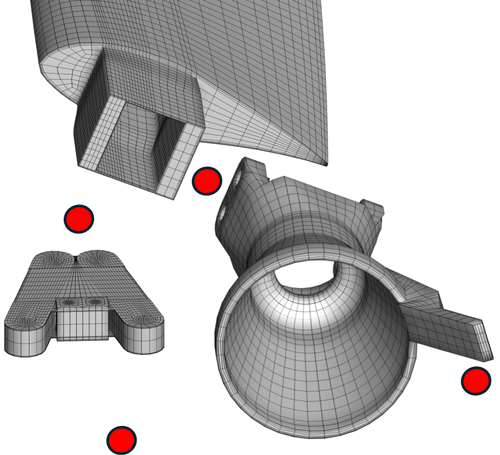
Computational Structural Dynamics (CSD) research seeks to predict the unsteady three-dimensional stresses/strains in rotating multi-body structures.
Rotary-wing structures are flexible, composite, and thin layered, characterized by large deformations, nonlinear inertial couplings, interactions between rotating and fixed components, joints with large rotations, resonant modes, and periodic aerodynamic forcing.
They require special finite element analysis (FEA) to account for rotation, nonlinear strains, multibody dynamics for joints, special parallel solvers in time and space for large scale problems, and suitable algorithms for coupling with CFD. One of the first scalable 3D FEA-multibody solvers for rotorcraft—X3D is developed and used for research at AGRC.
Faculty

Rotorcraft Comprehensive Analysis
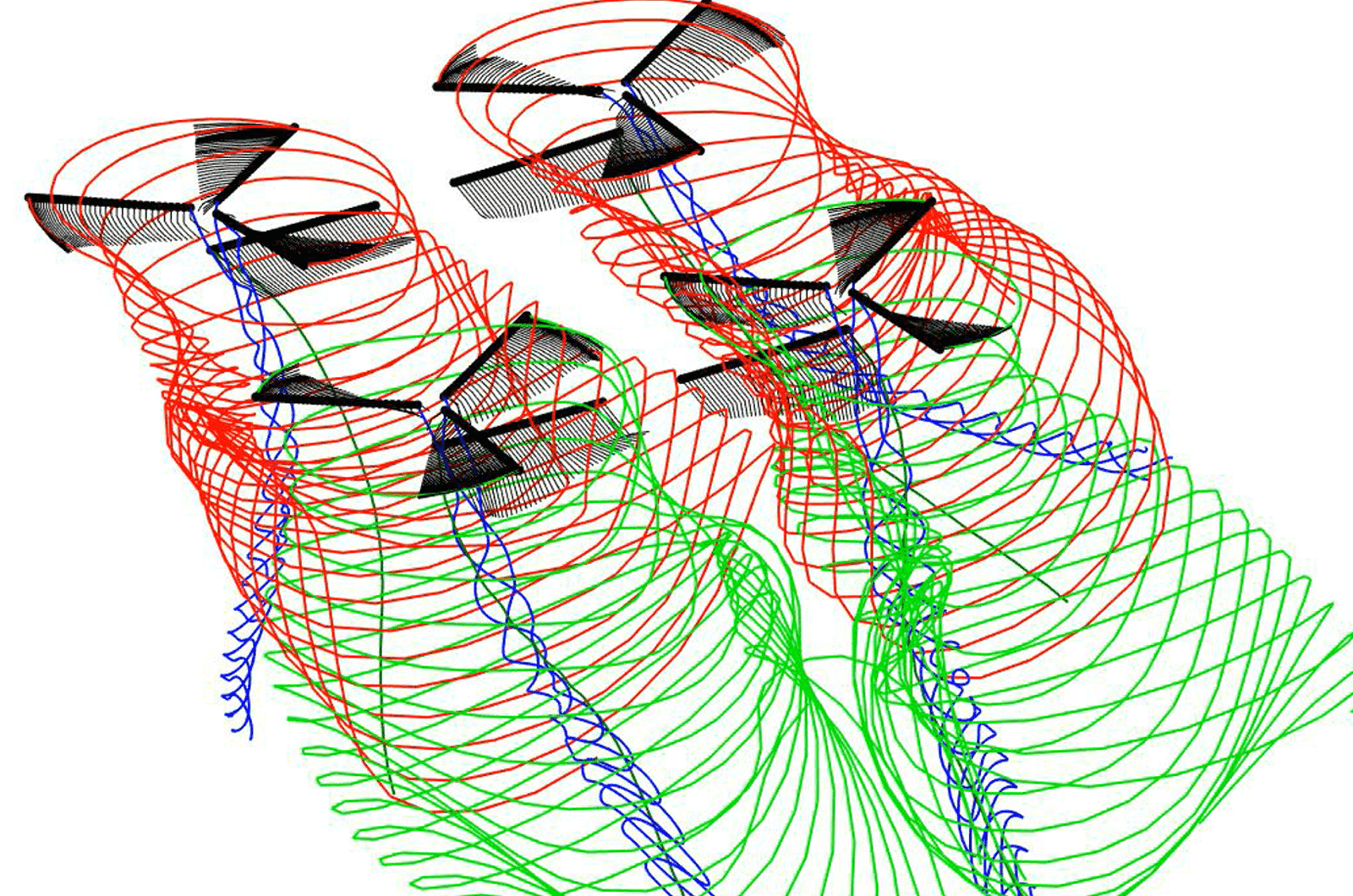
Rotorcraft Comprehensive Analysis (CA) is a special class of solvers that cleverly combine all disciplines—aerodynamics, structures and controls—to model a full aircraft.
The disciplinary equations must be in their reduced or lower order forms to achieve this combination (due to enormous mismatch in scale) but must achieve an equal level of fidelity for balance in physics. These solvers are important to predict performance, loads, vibrations, and aeroelastic stability of the full aircraft. Typically they use unsteady lifting-line models with 2D airfoil tables (from CFD or wind-tunnel tests) for aerodynamics, free-wake models for inflow, beam finite element models with 2D sectional properties (from CSD or structural tests) for structure, modes for wings and fuselages, and can handle multiple rotors and wings with interference.
The UMARC and UMARC-II analysis are developed and used at AGRC. UMARC was one of the first rotorcraft comprehensive codes in academia, developed first during the 1980s, and continuously refined and validated since then. It was one of the first codes to demonstrate coupling with CFD and establish the field of CFD/CA coupling (also called CFD/CSD coupling for symmetry of terminology). UMARC and UMTURNS were used to demonstrate the coupling. Today, UMARC-II is its modern variant.