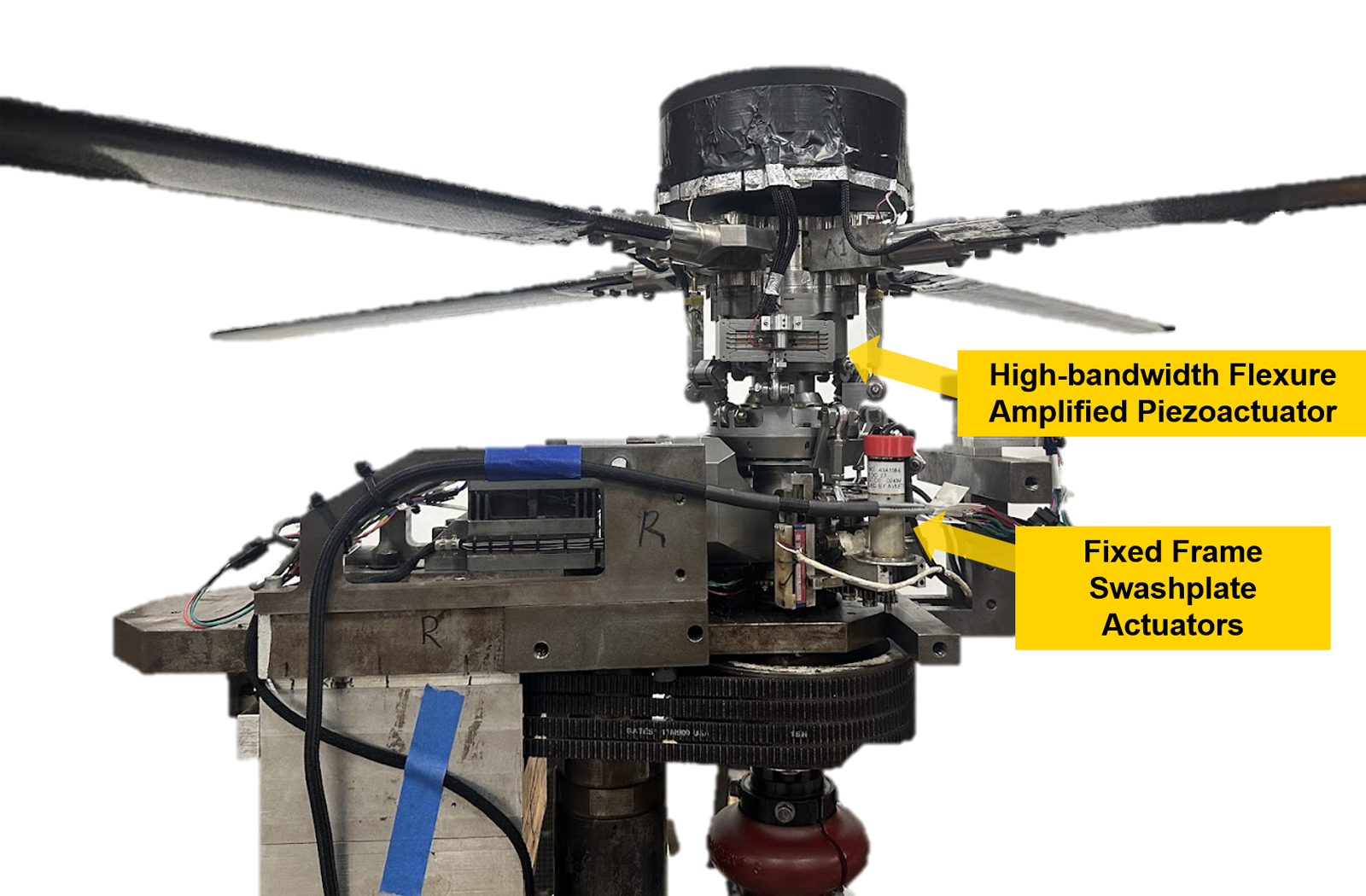
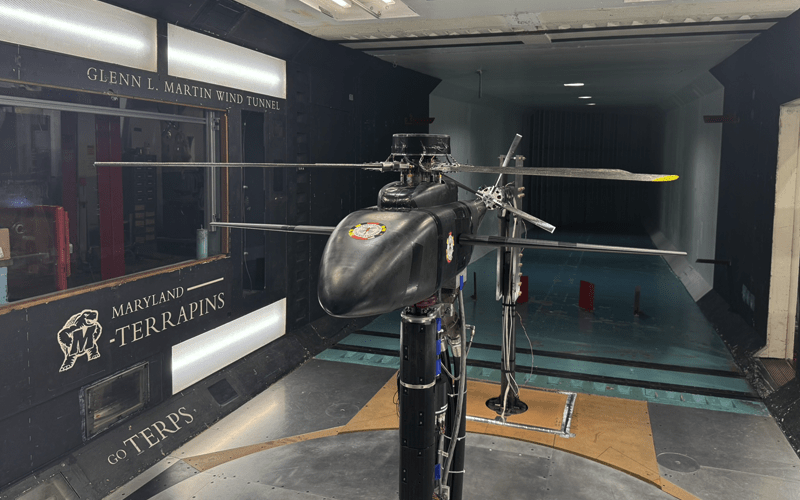
The Maryland Compound Rig is a 4-bladed helicopter rig with articulated and hingeless hubs supporting up to 6-ft diameter rotors for performanc, vibratory loads and stability.
In addition to the main rotor, it has a fuselage with interchangeable half and full wings with adjustable pitch angles, as well as an isolated pusher prop with an adjustable distance from the rotor hub.
A specialty of the rig is its independent load cells: one for the main rotor, one for each of the two wings, and one for the pusher prop.
Features:
- The main rotor has a 150-channel slip ring for rotating-frame sensors—blade flap, lag and torsion moments, pitch link loads, and blade pitch inputs.
- The main rotor is driven by a 60 hp hydraulic motor with a 2:1 ratio belt-pulley system.
- The main rotor pitch links can have steady (trim solution) and dynamic (stability solution) inputs.
- Wings can be set at various vertical and longitudinal locations and 0 to 12 degrees of angles of attack.
- Wings can be one-sided, two-sided, and two-sided with unequal angles of attack.
- The propeller is driven by an electric motor with electronic phase synchronization with main rotor, and the propeller pitch can be adjusted.
- The articulated hub and blades are loosely 1:9 Mach-scaled to the UH-60A Black Hawk rotor. Because the rotor is stiff in-plane, it does not use lag dampers.